KlaroNail Ingredients: 17 on the Bottle, 13 Online
The short version
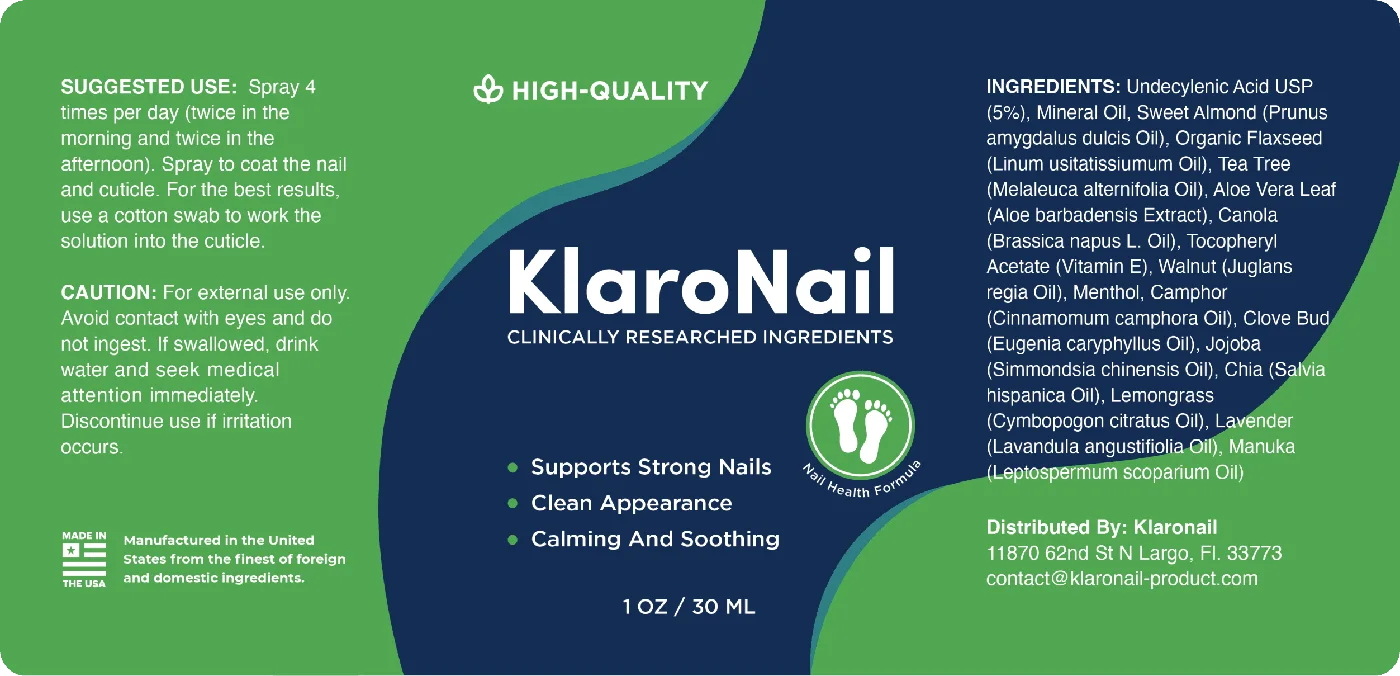
The full KlaroNail ingredients list is on the bottle, which names seventeen ingredients, while the sales page names thirteen. The four extra on the label are Mineral Oil, Canola, Jojoba and Lemongrass. The label opens with Undecylenic Acid, so it is the best guide to follow.
- Ingredients above one per cent are declared in descending order; the tail may be in any order.
- The page opens with Clove Bud; the label opens with Undecylenic Acid. Follow the label.
- A sales page is marketing copy. The printed declaration is the regulated document.
The four that are only on the bottle
Set the sales page's ingredient section beside a photograph of the printed label and four entries appear that have no counterpart on the page at all:
- Mineral Oil — second on the label, so above the one per cent line and likely the largest component after the undecylenic acid.
- Canola (Brassica napus L. Oil) — a refined seed oil, seventh.
- Jojoba (Simmondsia chinensis Oil) — thirteenth. Not technically an oil at all but a liquid wax ester, which is why it behaves differently on skin from the triglyceride oils around it.
- Lemongrass (Cymbopogon citratus Oil) — fifteenth.
Three of those four are unremarkable. The second entry is not.
Why Mineral Oil is the one that matters
Mineral oil is a highly refined petroleum distillate. In cosmetic use it is stable, inexpensive, does not oxidise the way plant oils do, and has a long safety record as an emollient. On its own merits it is a perfectly reasonable carrier for a product like this — and at second position it is doing real work, because a fine-mist spray needs a carrier that will spread thinly and not go rancid in a bathroom.
The difficulty is what is printed elsewhere. The sales page displays a badge reading “100% NATURAL INGREDIENTS”. A petroleum distillate at the second position of the declaration is not compatible with that, and neither is the canola oil further down nor the tocopheryl acetate, which is a synthetic ester of vitamin E rather than the vitamin itself.
That is why the badge does not appear anywhere on our pages. We are not accusing anyone of anything more interesting than a marketing department and a regulatory label being written by different people — but a claim contradicted by the product's own packaging is a claim we cannot repeat.
How the order works, and what it can tell you
An ingredient declaration on a cosmetic is not a free-form list. Ingredients present at more than one per cent are declared in descending order of predominance. Below one per cent, the remaining ingredients may be listed in any order at all, and colour additives come last.
Two useful things follow from that rule when you look at this panel:
- The top of the list is informative. Undecylenic Acid USP at 5% in first position, with Mineral Oil second, tells you the carrier structure of the product.
- The bottom of the list is not. Once you are past the one per cent threshold — and on a seventeen-item panel you get there quickly — the order carries no information. Lavender at sixteenth place could be at 0.9% or at 0.01%, and nothing on the bottle distinguishes those.
Compare that with the sales page, which opens its ingredient section with Clove Bud. On the label, clove bud is twelfth. The page's order is an editorial choice about which photograph makes the best opening image; the label's order is a rule. When they disagree, there is only one of them worth reading.
The practical version
If you are assessing any direct-to-consumer topical, the sequence that works is short. Find a legible photograph of the actual printed panel — not the page's ingredient carousel. Count the entries and compare the count with the page. Check whether the first two or three ingredients are consistent with any percentage the brand advertises. Then read the badges against the panel, in that order, because a badge is a claim and a panel is a declaration.
See the full transcription
All seventeen label ingredients are typeset on the product page, with the four page-only omissions marked.
Order NowFrequently asked questions
Why would a sales page list fewer ingredients than the bottle?
Sales pages are written to be persuasive and are usually built around a set of ingredient photographs. Ingredients with no attractive photograph, or with connotations the copywriter would rather avoid, tend not to make the cut. Nothing requires a marketing page to be complete; the printed declaration is the document that does have rules attached.
Is mineral oil a problem in a nail product?
Not inherently — it is a stable, well-tolerated emollient used in cosmetics for decades. The problem here is not the ingredient, it is the contradiction: a petroleum distillate on the label under a badge on the page claiming the formula is one hundred per cent natural.
What are the ingredients in KlaroNail?
The KlaroNail bottle lists seventeen ingredients, opening with Undecylenic Acid. The label also includes Mineral Oil, Canola, Jojoba and Lemongrass, which the sales page does not name.